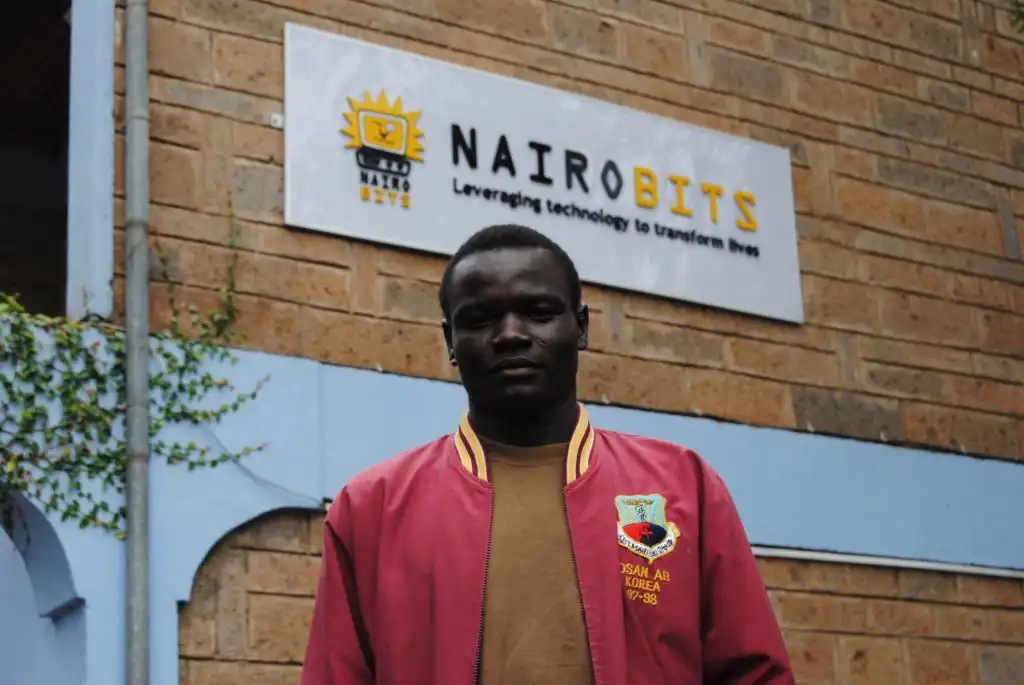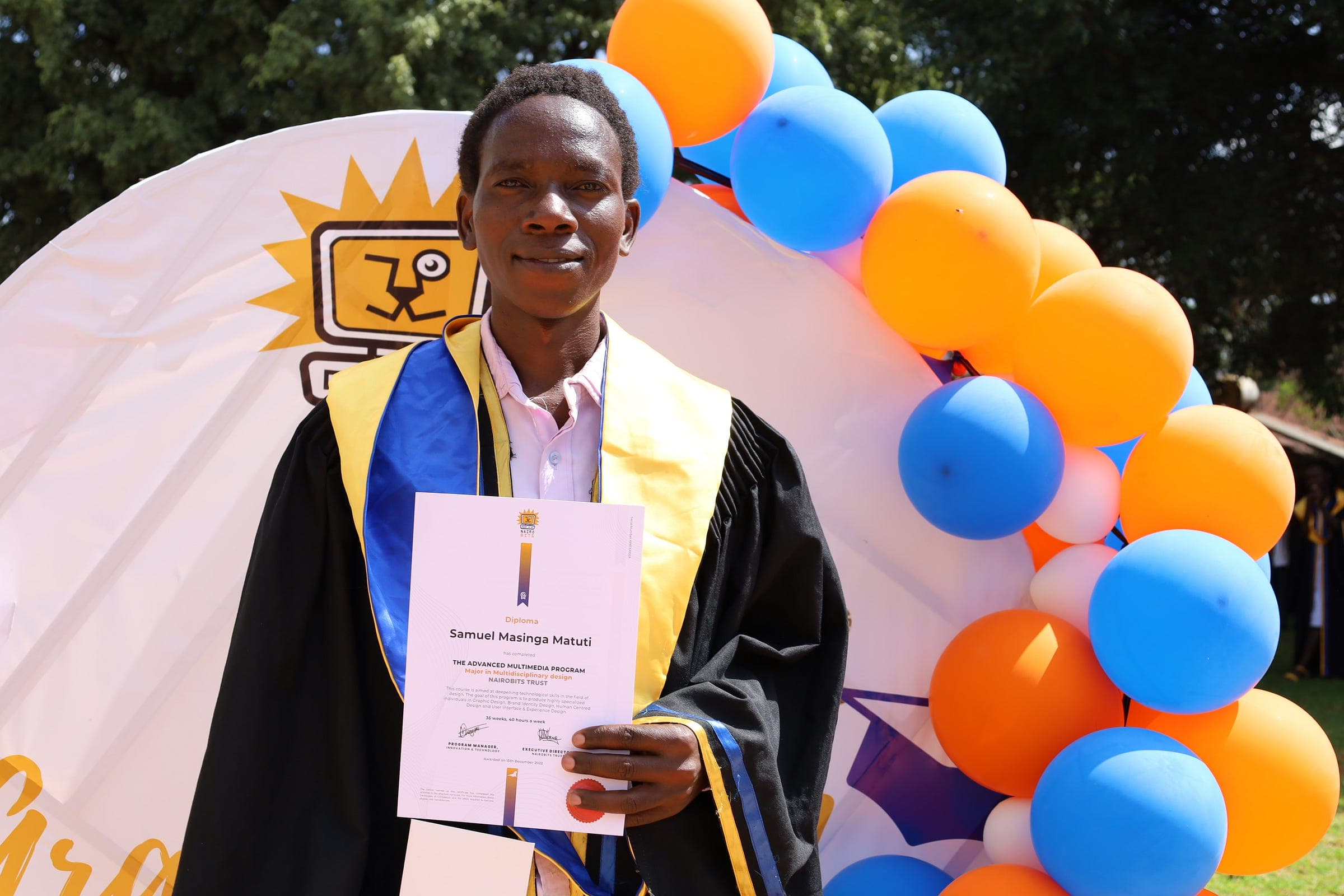
The journey of a thousand miles starts with one step. For Dafala Dafala, his started in the kitchen.
Long before graphic design entered his life, Dafala’s world revolved around recipes and cooking, a skill he had built with care but one that led nowhere close to the career he actually wanted. Getting there meant finding mentorship and real training, both out of reach for many young people in under-resourced Nairobi communities. According to a joint World Bank and International Finance Corporation study, only an estimated 5 to 10 percent of Kenyan households are expected to be able to afford digital skills training by 2030. It is precisely this gap that NairoBits Trust, a Nairobi-based organization equipping underserved youth with digital and life skills, built its Digital Literacy Program (DLP) to close. Dafala nearly became part of that statistic before he had even started.
Like many NairoBits learners, Dafala first found the program through a former student, word of mouth from someone who had already walked the path being one of the organization’s strongest ways of reaching young people in the community. But the name alone almost wasn’t enough. Dafala assumed the program would cost more than he could manage, unaware that NairoBits deliberately keeps DLP fees subsidized and affordable, precisely so that cost is never the reason a young person misses out. It was only when he pushed past that assumption and looked into it properly that he discovered the fees were within reach, and enrolled.
At the height of the Nairobi rains, Dafala found himself caught in a quiet dilemma: whether to keep pushing through a commute the weather seemed determined to punish, or let it wear him down. According to a study on youth empowerment programs in Nairobi’s informal settlements published in PLOS ONE, transport costs are consistently the biggest reason young people in the city’s informal settlements drop out of programs meant to help them. It is exactly this kind of gap that NairoBits’ wraparound support model is designed to close: mentorship, transport support, and enterprise support alongside the technical training itself.
In Dafala’s case, that meant backing a small donut business he was already running, its income keeping him moving to class no matter what the skies decided to do. But one night, that dilemma grew too big to ignore. The floods came harder than usual, and Dafala didn’t reach home until close to 11 p.m., soaked through, only to find the electricity had failed as well. Standing in the dark, tired in a way that had nothing to do with sleep, he allowed himself, just for a moment, to wonder if it was all worth it.

Unlike many of his peers, Dafala had no children or dependents pulling at his time and resources, and that space let his resolve speak louder than his exhaustion. The reason he had started this journey hadn’t changed, he reminded himself, and rain, however relentless, always passes. The storm wanted to sweep his will away that night. It didn’t succeed.
A Turning Point
Every journey has a moment that quietly shapes the rest of it. For Dafala, his came during a PowerPoint module on how to build and deliver a presentation, one of the practical, portfolio-facing projects built into the DLP curriculum. He had struggled through it, unsure if his slides made sense, and braced for the worst as he presented his work. Instead, his teacher offered feedback aimed at what could improve, not what had gone wrong. It stung at first, but the feedback outlasted the sting and reshaped how he saw mistakes altogether: not failures as he believed but as part of learning. He left more confident than he arrived, and that shift has held since.
By the time the program ended, that confidence sat alongside something else: uncertainty. Dafala describes completing the program as a mix of both, real excitement about finally having practical experience behind him, and real nerves about a professional world he still had to learn how to navigate.
Life After DLP
Today, Dafala is putting that training to work, taking on graphic design projects and steadily building a portfolio he can show clients. His days look different now, structured around practice, outreach, and the next opportunity rather than uncertainty about what comes next.
He is stepping into a job market that increasingly expects exactly what he has. According to the Skills Gap and Gender Analysis Report 2025, produced by BrighterMonday Kenya and the Mastercard Foundation, 75.9 percent of employers in Kenya now rank ICT and digital skills among the most essential competencies they look for.
This is exactly why NairoBits trains young people in ICT and digital skills in the first place: since its founding in 1999, the organization has reached over 100,000 young people, many of whom, like Dafala, have gone on to employment or self-employment using the skills they gained. What was once a specialized advantage has become closer to a baseline requirement, and Dafala already has it.

At its core, Dafala’s journey is not only about learning graphic design. It reflects persistence, community support, and the understanding that a setback does not have to be an ending. His advice to others on a similar path is straightforward:
“Believe in yourself, ask questions, and keep practicing. The journey may not always be easy, but the skills and opportunities you gain can truly change your life.”
From a kitchen in Kariobangi to a growing career in design, Dafala’s story is a reminder of what becomes possible when opportunity meets determination.
Dafala’s story is one of many. NairoBits exists to positively change the lives of vulnerable youth by improving their ability to contribute to their own socio-economic well-being through creativity and innovation using ICT, working toward a vision of becoming a center of excellence for youth empowerment in creativity and innovation through technology. Every learner who walks through our doors, and every donor, partner, or volunteer who supports them, moves that vision forward.
If Dafala’s story moved you, consider enrolling in DLP, partnering with NairoBits, or supporting the program directly. Join the Bits family today
Sources
- World Bank / International Finance Corporation, Demand for Digital Skills in Sub-Saharan Africa. https://documents1.worldbank.org/curated/en/099614312152318607/pdf/IDU0b36e9e030767f0417e0afb806e2ffdf1e8bf.pdf
- Experiences of integrating a psychological intervention into a youth-led empowerment program targeting out-of-school adolescents, in urban informal settlements in Kenya, PLOS ONE / PMC. https://www.ncbi.nlm.nih.gov/pmc/articles/PMC10990221/
- BrighterMonday Kenya and the Mastercard Foundation, The Skills Gap and Gender Analysis Report 2025, as reported by HapaKenya. https://hapakenya.com/2025/11/06/new-report-reveals-massive-skills-gap-digital-divide-blocking-jobs-for-kenyas-youth/